Berita IAI
Navigate to:
How Indonesia Is Preparing Future Ready Accountants Through Research Education and Collaboration
18 September 2026 - Siaran Pers
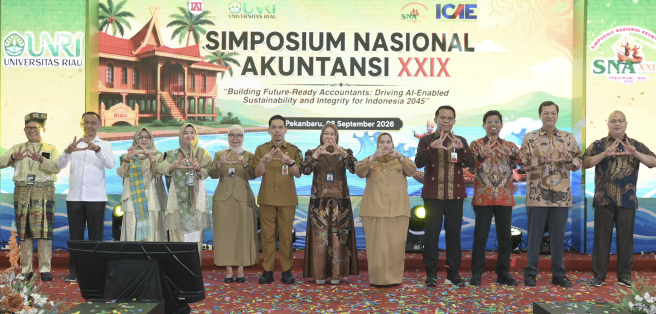
How the Institute of Indonesia Chartered Accountants (Ikatan Akuntan Indonesia/IAI) is bringing educators, professionals, and industry together to respond to AI, sustainability, and changing expectations
Artificial intelligence can process information in seconds, but speed alone does not create trust. Accountants must still understand context, challenge assumptions, assess consequences, and take responsibility for the decisions informed by that technology. This conviction shaped the Institute of Indonesia Chartered Accountants’ approach to the 29th National Accounting Symposium, or SNA XXIX Riau, and the 2026 International Conference for Accounting Educators.
Held with Universitas Riau on September 8–10, 2026, the event brought the academic and professional communities together under the theme “Building Future-Ready Accountants: Driving AI-Enabled Sustainability and Integrity for Indonesia 2045.” It was designed as more than an annual research conference. For IAI, it was part of a broader effort to ensure that accounting education, research, and professional development evolve together as technology and public expectations reshape the profession.
Why IAI pursued this initiative
The profession is facing several transitions at once. AI is changing how routine work is performed and expanding what can be learned from data. Sustainability considerations are becoming increasingly relevant to business decisions and reporting. At the same time, society continues to expect accountants to protect the credibility of information and uphold the public interest.
These developments raise a practical question for a professional accountancy organization: How can we help current and future accountants use new capabilities without weakening professional judgment, ethics, or accountability? IAI believes the answer must begin before an accountant enters the workplace. Universities influence how future professionals learn to question evidence, interpret complexity, and recognize the human consequences of decisions. The profession, meanwhile, can help educators understand how roles and expectations are changing in practice.
That is why IAI uses the symposium as a bridge between research, education, and professional practice. It provides a national forum where evidence can be tested, teaching approaches can be discussed, and emerging issues can be translated into relevant learning and development priorities.
Turning a conference into a platform for action
SNA XXIX Riau combined keynote addresses, international sessions, a poster festival, parallel research presentations, discipline-based discussions, and academic forums. Its scope covered undergraduate, graduate, doctoral, vocational, and professional accounting education, as well as financial accounting, taxation, management accounting, Islamic accounting, auditing, information systems, the public sector, governance, and corporate social responsibility.
The level of participation demonstrated the strength of Indonesia’s accounting research community. The symposium received 355 papers and posters: 283 research papers and 72 posters. Of these submissions, 244 were presented online and 111 in person. The hybrid format expanded access for participants from across the country while preserving direct academic interaction in Pekanbaru.
The numbers matter, but the more important measure is what happens after a paper is presented. IAI encouraged participants to consider how their findings could improve public policy, curricula, organizational practices, and responses to real challenges in Indonesia. As Ardan Adiperdana, President of IAI, observed, the symposium is not merely a place to present research. It is where ideas meet, evidence is tested, networks are formed, and accounting education and practice are renewed.
Keeping people responsible in an AI enabled environment
A central message throughout the program was that technology changes the accountant’s work but does not remove human responsibility. AI can accelerate processes and extend analytical capacity. Accountants must still determine whether information is reasonable, traceable, relevant, and worthy of trust.
Prof. Akhsanul Khaq, Member III of the Audit Board of the Republic of Indonesia and a member of IAI’s Supervisory Board, emphasized that trust is an outcome of sound governance, not simply technological capability. As routine processing becomes more automated, accounting professionals will need a wider combination of accounting and assurance knowledge, data and AI literacy, sustainability awareness, cybersecurity understanding, business acumen, ethics, and leadership.
This has direct implications for education. The question is no longer whether students will use AI, but how institutions will integrate it responsibly into curricula, research, and learning. Technical proficiency remains essential, yet future professionals must also be able to interpret data, exercise skepticism, explain their reasoning, and understand the wider effects of their recommendations.
Closing the gap between education and employment
The symposium also supports a wider IAI initiative to narrow the gap between university learning and industry expectations. Through collaboration between IAI’s Accountants Educators Compartment and Accountants in Business Compartment, universities, business leaders, and practitioners are comparing three perspectives: international education and competence expectations, what higher education institutions currently deliver, and what organizations increasingly need from new professionals.
The purpose is not to create another competency map. It is to identify specific gaps and develop a practical road map for addressing them. Possible actions include curriculum enhancement, joint learning modules, microcredentials, internships and cooperative education, stronger engagement by practitioners, and applied research that responds to business and societal needs.
This approach recognizes that no institution can prepare future-ready accountants on its own. Universities bring research capability and learning expertise. Employers contribute current insight into changing roles and technologies. The PAO connects these communities, anchors the conversation in professional values and competence, and helps turn dialogue into coordinated action.
What comes next
SNA XXIX Riau reinforced a simple lesson for IAI: professional relevance depends on sustained collaboration. A conference can convene the right people, but its lasting value comes from the relationships, research agendas, curriculum changes, and professional development activities that follow.
IAI will continue connecting educators, researchers, practitioners, regulators, and students so that innovation strengthens rather than displaces professional judgment. As Indonesia works toward its 2045 development ambitions, the profession must equip accountants not only to work with advanced technology, but also to ask better questions, make responsible decisions, and protect public trust.
As AI and sustainability reshape work in every jurisdiction, how can PAOs, educators, and employers collaborate more effectively to ensure that the next generation of accountants is both technologically capable and grounded in integrity?